



Understand energy transfer in blasting and shot peening
Use the calculator below to estimate the impact energy of your abrasive particles based on mass and velocity.
Blasting and shot peening are fundamentally energy transfer processes.
When an abrasive particle hits a surface, the energy it carries is released and transformed. This energy is what allows the process to remove contaminants, clean surfaces, or introduce compressive stresses.
In blasting, the energy given to the particle is not lost. It is redistributed into different physical effects at impact.
“Nothing is lost, nothing is created, everything is transformed.”
Antoine de Lavoisier
Why impact energy matters
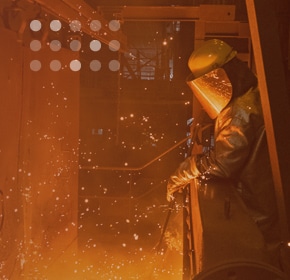
During blasting, particles are accelerated to high speed before striking the surface. At impact, their kinetic energy is transferred to the material.
This is what allows the process to work: removing sand or scale, cleaning the surface, or generating compressive stresses in shot peening.
In simple terms, blasting is nothing more than energy being transferred from the abrasive particle to the surface.
Higher energy generally improves effectiveness. But in practice, the objective is not to maximize energy at all costs. What matters is finding the right balance between performance, control, and equipment constraints.
The impact energy formula
The impact energy of a particle is calculated using the classical kinetic energy equation:
E = ½ × m × v²
Where m is the particle mass and v its velocity at impact.
This formula highlights one key point: velocity has a major influence on energy, because it is squared.
In practical terms, increasing speed slightly can have a much larger effect than increasing particle mass.
A simple example
Take a particle with a mass of 0.2 grams (0.0002 kg) traveling at 50 m/s.
Applying the formula gives an impact energy of 0.25 joules.
This value may seem small, but when multiplied by thousands of particles hitting the surface every second, the total energy becomes significant.
What happens to the energy at impact
When a particle hits the surface, its energy is not used in a single way. Part of it is useful, and part of it is lost through different mechanisms.
The useful part is the energy that actually performs the work: removing contaminants, modifying the surface, or generating residual stresses.
The rest is distributed into effects such as heat, rebound inside the machine, or even deformation and breakage of the particle itself. These phenomena are unavoidable, but they reduce the overall efficiency of the process.
Understanding this distribution helps explain why two setups with similar parameters can deliver different results.
Why 80 m/s is often used
In many industrial applications, blasting velocity is typically around 80 m/s.
This value is not random. It has become a reference because it offers a good compromise between cleaning efficiency, productivity, and equipment wear.
Increasing velocity will increase impact energy, but it will also accelerate machine wear and abrasive degradation. That’s why, in practice, operators aim for a balanced operating range rather than maximum speed.
The role of abrasive type
The material of the abrasive also plays a key role in how energy is transferred.
High carbon steel abrasives are generally more efficient in transferring energy for a given particle size. They allow a more effective impact under similar conditions.
Low carbon abrasives behave differently. They tend to reduce wear and consumption, but they also transfer less energy. This means that process parameters may need to be adjusted to achieve the same result.

Why impact energy is only part of the picture
Impact energy is an important parameter, but it does not define performance on its own.
In real conditions, efficiency also depends on how many particles hit the surface, how they are distributed, and how long the process lasts.
A large particle may deliver high energy, but fewer impacts occur. Smaller particles may cover the surface faster, but with lower energy per impact.
That is why blasting is always a matter of balance between energy and particle flow.

Use the impact energy calculator
This calculator gives you a simple way to estimate the energy delivered by your abrasive particles.
It helps you better understand how mass and velocity influence your process, and how to adjust your parameters to reach the desired result.
Want more resources for your blasting process ?
Sign up for our weekly newsletter
"*" indicates required fields

